
On this page
- What the Law Requires: 15 Units per Acre, 50 Acres Minimum, By Right
- Why It Matters Right Now: 165 of 177 Communities Compliant, 9 Sued
- North Shore Town-by-Town Compliance Status
- What “By Right” Means for Buyers
- What “By Right” Does Not Mean
- How This Affects Property Values
- What Sellers Should Know Before Listing
- The Enforcement Picture in 2026
- FAQ
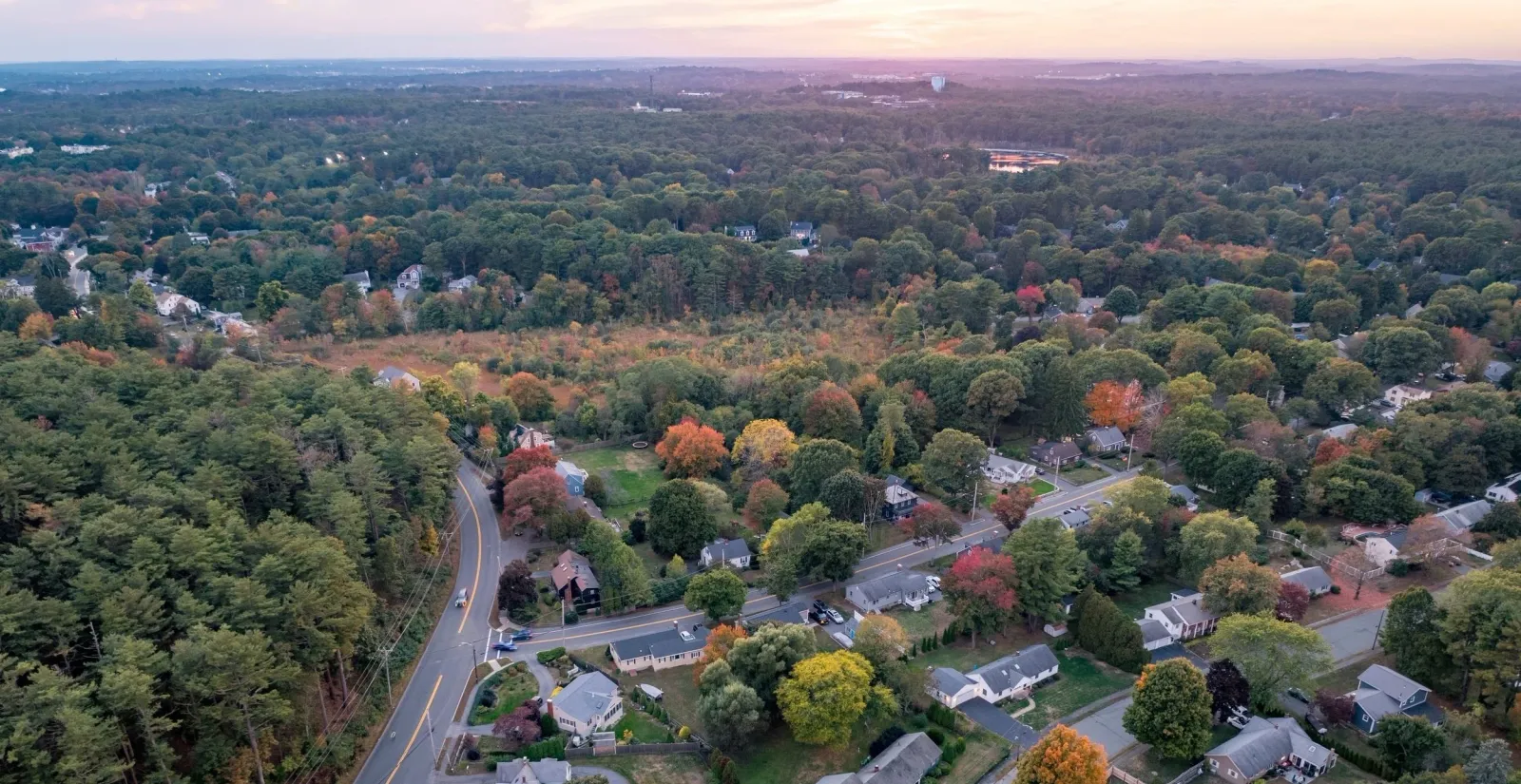
The MBTA Communities Act — formally Section 3A of Massachusetts General Laws Chapter 40A — requires every city and town served by or adjacent to the MBTA to allow multifamily housing as of right in at least one zoning district near transit. Signed into law in January 2021, the law covers 177 communities across the state. For North Shore buyers and sellers, it is the most significant shift in local zoning in a generation.
Last verified: October 13, 2026. Compliance statuses change as towns vote and EOHLC reviews applications — check mass.gov/mbta-communities for the current list.
What the Law Requires: 15 Units per Acre, 50 Acres Minimum, By Right
Every covered community must designate at least one zoning district where multifamily housing is permitted by right — meaning no special permit, no town meeting vote on individual projects, no ZBA hearing for each building. The district must allow a minimum gross density of 15 units per acre, cover at least 50 acres of land, and be located within a half-mile of a transit station or other qualifying MBTA service area. The district cannot impose age restrictions or other occupancy limits that would prevent families with children from living there.
The law does not require a single unit to be built. It requires the zoning to exist. Whether development actually follows depends on land availability, market conditions, and individual property owners.
Why It Matters Right Now: 165 of 177 Communities Compliant, 9 Sued
As of early 2026, 165 of the 177 covered communities have achieved some form of compliance — district, conditional, or interim. Of those, 133 have full district compliance certified by EOHLC; 7 are in conditional compliance (districts agreed in principle, pending local votes); and 25 are in interim compliance with action plans under review. The Massachusetts Attorney General filed suit on January 29, 2026, against nine towns that missed their July 14, 2025, deadline — a list that included Marblehead. The Supreme Judicial Court has confirmed the law is constitutional and enforceable. In September 2026, the SJC rejected the latest legal challenge, brought by Marshfield, on every argument raised.
Towns that remain out of compliance lose eligibility for MassWorks infrastructure grants, the Housing Choice grant program, the Local Capital Projects Fund, and MassHousing financing programs. The financial stakes are real: Middleton lost a $2 million MassWorks grant; Marblehead was rejected for a $735,000 seawall study grant.
North Shore Town-by-Town Compliance Status
Here is where each town Sherwood & Company serves stands as of the date this page was last verified. Statuses are drawn from EOHLC district compliance letters, the AG press release (January 29, 2026), and local reporting through October 2026.
Beverly — Fully compliant. EOHLC issued a formal determination of compliance on April 25, 2025, certifying Beverly’s MBTA Communities Overlay District. Beverly is a Commuter Rail community and was already largely in compliance before the law passed.
Salem — Fully compliant. Salem was among a small group of communities whose pre-existing zoning already met the law’s requirements, confirmed by EOHLC. Salem is a Commuter Rail community on the Newburyport/Rockport Line.
Danvers — Fully compliant. Danvers adopted a compliant multifamily overlay and appears in the EOHLC pipeline as an active compliance community as of January 2026.
Peabody — Fully compliant. After initial City Council resistance, Peabody adopted a scaled-back overlay district that achieved compliance. The city is a Commuter Rail community.
Gloucester — Fully compliant. After a citizen petition suspended the City Council’s original Multi-Family Overlay District, Gloucester held a special election on April 24, 2025. Voters approved the overlay district 3,668–2,431 (60%–40%), bringing the city into compliance ahead of the July 14, 2025, state deadline.
Manchester-by-the-Sea — Fully compliant. EOHLC issued a letter of compliance to Manchester-by-the-Sea on August 6, 2025, determining that the town’s MBTA zoning plan meets the necessary criteria.
Swampscott — Fully compliant. Swampscott appears in the EOHLC district compliance letters list (as of December 2025).
Lynnfield — Fully compliant. Lynnfield appears in the EOHLC district compliance letters list (as of December 2025).
Hamilton — Fully compliant. A Special Town Meeting on July 14, 2025, passed the MBTA Communities Zoning article 334–269. EOHLC subsequently issued a formal Determination of Compliance for Hamilton. Hamilton is a Commuter Rail community that shares a station with Wenham and was required to zone a minimum 49-acre district capable of supporting 731 units.
Marblehead — Interim compliance, district application under EOHLC review. Marblehead’s path was unusually turbulent: Town Meeting approved a compliant overlay in May 2025 (951–759), a citizen referendum overturned it in July 2025 (3,642–3,297), and the Attorney General sued the town in January 2026. EOHLC’s February 5, 2026, pre-adoption review found no conflicts with state requirements. At the May 4, 2026, annual Town Meeting, voters approved a new compliance plan 881–82. Marblehead submitted its district compliance application and is now in interim compliance while EOHLC reviews it. [VERIFY: Confirm whether EOHLC has issued a full district compliance determination for Marblehead since the May 4, 2026, Town Meeting vote. Check mass.gov/mbta-communities for current status.]
Rockport — District adopted; federal challenge dismissed. Rockport adopted a compliant Multi-Family Overlay District (MCMOD) at a Special Town Meeting in 2022. On January 26, 2026, the U.S. Court of Appeals for the First Circuit upheld the district against constitutional and statutory challenges brought by eleven residents. [VERIFY: Confirm whether EOHLC has issued a formal district compliance certification for Rockport. The district exists and survived federal court challenge, but EOHLC certification status was not confirmed in available sources as of this writing. Check mass.gov/mbta-communities.]
Wenham — [VERIFY: Confirm current EOHLC compliance status for Wenham. Wenham achieved interim compliance in February 2025 and planned a Special Town Meeting for June 9, 2025, to vote on district zoning (24-acre district, 365-unit minimum). Confirm whether the June 2025 Town Meeting adopted a compliant district and whether EOHLC has issued a district compliance determination. Check mass.gov/mbta-communities.]
Ipswich — [VERIFY: Confirm current EOHLC compliance status for Ipswich. Ipswich submitted an action plan on February 12, 2025, and planned a Town Meeting vote on May 13, 2025, on a compliant overlay district (50-acre minimum, 971-unit capacity). Confirm whether Town Meeting adopted the district and whether EOHLC has issued a compliance determination. Check mass.gov/mbta-communities.]
Essex — [VERIFY: Confirm EOHLC compliance status for Essex. Essex is an MBTA Communities covered town. Its post-2025 compliance status was not confirmed in available sources. Check mass.gov/mbta-communities for current status.]
Middleton — In litigation. Middleton was one of the nine towns sued by the AG on January 29, 2026. As of mid-2026, Middleton had submitted an answer asserting affirmative defenses and filed formal counterclaims. Middleton’s separate appeal of an Essex County Superior Court ruling on its community-category argument is pending in the Appeals Court (Dkt: 2025-P-1173). Middleton has not adopted a compliant district and remains ineligible for state grant funding. [VERIFY: Confirm whether Middleton has since voted to comply or remains in litigation. Check mass.gov/mbta-communities.]
What “By Right” Means for Buyers
When a zoning district allows housing by right, a developer who meets the dimensional standards on paper can pull a building permit without going before a board. That is a meaningful change in towns where multifamily projects previously required a special permit — a public hearing process that neighbors could use to delay or block projects.
For buyers, this means that in designated 3A districts, the risk of a neighboring parcel being developed into a multifamily building is higher than it was before the law. That is not necessarily bad news — more housing supply tends to moderate price pressure over time — but it is a real change in what a buyer is purchasing when they buy near a transit station in a compliant town.
For sellers, a property inside or adjacent to a 3A district may attract a different buyer pool than it did five years ago: developers and investors who see the by-right zoning as reducing permitting risk. That can be a positive for pricing, particularly on larger lots.
What “By Right” Does Not Mean
The law does not require any development to occur. A 3A district is a zoning designation, not a construction order. If no developer buys land in the district, nothing gets built. Many compliant towns have drawn their districts over already-developed land, golf courses, or commercial areas where residential development is unlikely in the near term.
The law also does not override local site plan review, building codes, stormwater regulations, or historic district requirements. A project in a 3A district still needs a building permit, still must comply with Title 5 for septic, and still must meet all state environmental standards. What it does not need is a special permit from the ZBA or Planning Board for the use itself.
How This Affects Property Values
The honest answer is: it depends on the town and the specific location. The AG’s January 2026 press release cites approximately 7,000 new homes in the pipeline across 34 communities statewide as a direct result of 3A rezoning — a meaningful addition to supply in a region that has chronically underbuilt.
In walkable downtown areas — Salem, Beverly, Danvers — where the 3A district overlaps with existing commercial and mixed-use zones, the practical effect on single-family neighborhoods is likely modest. The land that gets developed is typically already commercial or underutilized. In smaller towns where the district was drawn over residential land, the calculus is different.
If you are buying near a transit station in any North Shore town, ask your agent to pull the 3A district map for that community. It is public record and available through the town planning department or the MassGIS District Atlas.
What Sellers Should Know Before Listing
If your property is inside a 3A district, that fact is material and should be disclosed in your listing. Buyers — especially developers — will find it in due diligence, and surfacing it early builds trust and avoids surprises at the purchase-and-sale stage.
If your property is adjacent to a 3A district, the same logic applies. A buyer who later discovers that the vacant lot next door is zoned for 40-unit multifamily housing by right may feel misled if nobody mentioned it. Massachusetts does not have a mandatory seller disclosure form, but Chapter 93A’s consumer protection standards mean that material omissions can create liability.
Your listing agent should be able to pull the 3A district boundaries and include a plain-English note in the property description. Sherwood & Company does this as a matter of course on every listing near a transit station.
The Enforcement Picture in 2026
The AG’s January 2026 lawsuit against nine towns — Dracut, East Bridgewater, Halifax, Holden, Marblehead, Middleton, Tewksbury, Wilmington, and Winthrop — is still working through the courts. Marblehead has since voted to comply and is in interim compliance. Of the remaining eight, Halifax, Middleton, Tewksbury, Wilmington, and Winthrop submitted answers asserting affirmative defenses; Middleton, Tewksbury, and Winthrop also filed formal counterclaims. Dracut’s motion to dismiss was rejected by the court in April 2026.
The SJC’s September 2026 ruling rejecting Marshfield’s challenge makes clear that the constitutional arguments against the law have been exhausted. The question for holdout towns is no longer whether the law is valid — it is — but how long they can delay compliance before a court orders it.
For buyers and sellers in those towns, the uncertainty cuts both ways. Non-compliant towns are ineligible for significant state grants, which can affect local services and infrastructure spending. But the zoning itself has not changed in those towns, so the immediate development risk is lower than in compliant communities.
FAQ
Does the MBTA Communities Act force towns to build apartments?
No. The law requires towns to adopt zoning that allows multifamily housing by right in a designated district. It does not require any development to occur, and it does not override a property owner’s decision about what to do with their land. Whether apartments actually get built depends on market conditions, land availability, and developer interest.
Can a town change its 3A district after it is approved?
A town can amend its 3A zoning, but any amendment that reduces the district below the minimum size or density requirements would put the town back out of compliance and trigger the loss of state funding eligibility. EOHLC must review and certify any material changes. Towns have some flexibility in how they draw the district, but not in whether they have one.
If I buy a house near a 3A district, will my neighborhood change?
It may, over time. By-right zoning removes the special permit hurdle for multifamily projects, which makes development more predictable for builders. But most 3A districts are drawn near transit stations and commercial areas, not deep in single-family neighborhoods. The pace of actual change depends on land costs, construction costs, and financing — all of which remain challenging in 2026.
Does the law affect condo conversions or ADUs?
The 3A law is specifically about multifamily zoning districts and does not directly govern individual ADUs or condo conversions. Those are addressed by separate state laws — the 2024 Affordable Homes Act created statewide ADU rights, and condo conversions are governed by the master deed and condo docs process under M.G.L. c. 183A. The two sets of rules can interact, but they are distinct.
What happens if a town is sued and still does not comply?
The Attorney General’s lawsuit seeks a court declaration that the town is in violation and an injunction ordering adoption of a compliant district. If a town defies a court order, it faces contempt proceedings. The court can also order the state to withhold additional categories of local aid beyond the grant programs already at stake. The SJC has made clear it will not entertain constitutional challenges to the law.